
The Future of SaaS Pricing: Adaptive Models That Actually Work in 2025
SaaS founders and teams in 2025 face a storm of change. As user expectations skyrocket, static pricing is rapidly falling out of favor. The cost of SaaS marketing is up, buying cycles keep shrinking, and your competitors already test dozens of new pricing models each quarter. You know sticking to decade-old playbooks is risky, but the shift to adaptive pricing is full of unknowns: How do you avoid the struggle of churn from unhappy customers? Can you really align price with value in fast-changing markets?
TLDR
- Adaptive SaaS pricing models in 2025 consistently boost growth and retention compared to static pricing.
- Success lies in dynamic segmentation, usage-based tactics, and real-world data iterations, not guesswork.
- Start with small experiments, measure rapid feedback loops, and stay flexible for maximum ARR impact.
The Struggle with SaaS Pricing in 2025: Why Static Models Fail
Static pricing tiers made sense a decade ago, but today, they often block ARR growth and damage customer retention in SaaS. In my own experience advising fast-scaling product-led startups, I regularly see high churn when generic pricing outpaces the customer’s perceived value. For example, one SaaS startup I worked with saw churn rates jump 22% within three months after a price hike, even as its features improved. Why? Their prices were disconnected from real-world usage and buyer needs.
Competing SaaS brands now routinely test usage-based, value-based, and hybrid models, optimizing everything from onboarding flows to limits and add-ons. Customers expect transparency, customization, and ongoing value. According to a 2024 SaaS pricing report , over 60% of B2B buyers now prefer adaptive models. If your pricing strategy ignores these trends, you risk higher acquisition costs and faster churn. Learn more about the history and pitfalls of static pricing models in our deep dive: SaaS pricing models explained .
Opportunity: Adaptive SaaS Pricing Models for 2025 Growth
Switching to adaptive SaaS pricing in 2025 is not just a defensive move. It opens up unbeatable upsell and expansion pathways, cuts wasted acquisition spend, and fuels customer-first marketing strategies. By letting value drive payments, you unlock powerful PLG motion and boost customer lifetime value.
Last quarter, I saw a data analytics SaaS platform cut CAC by 30% in two months simply by migrating from static tiers to a usage-based structure, using dynamic segmentation. Their PLG funnel instantly became stickier because onboarding flows mapped perfectly to the trial experience. Adaptive models also let you pivot fast. If costs or user behavior shift, you adjust pricing policy in days, not months.
For those serious about modern SaaS growth strategy, linking value delivered to price paid is no longer a bold experiment, it’s a must-have. For related benchmarks, see our recent report: SaaS Growth Trends 2025 .

How SaaS Pricing Models in 2025 Power Everything from Retention to Demand Generation
SaaS pricing in 2025 is an engine for much more than revenue. Flexible models drive demand generation by lowering the barrier to entry. Smart, usage-based pricing supports customer retention in SaaS by scaling value and cost together. Your marketing should reinforce this adaptability too. For example, nurture campaigns highlighting cost predictability and personalized plans will convert faster and reduce decision friction.
Adaptive pricing also enables better churn reduction tactics. When users see a direct link between their usage, outcomes, and cost, they feel less “nickel-and-dimed” and more supported. This supports long-term engagement and builds trust, fortifying your SaaS community. To see how onboarding shapes these outcomes, check our practical guide: Onboarding strategies to reduce churn .
The Step-by-Step: Shifting to Adaptive SaaS Pricing in 2025
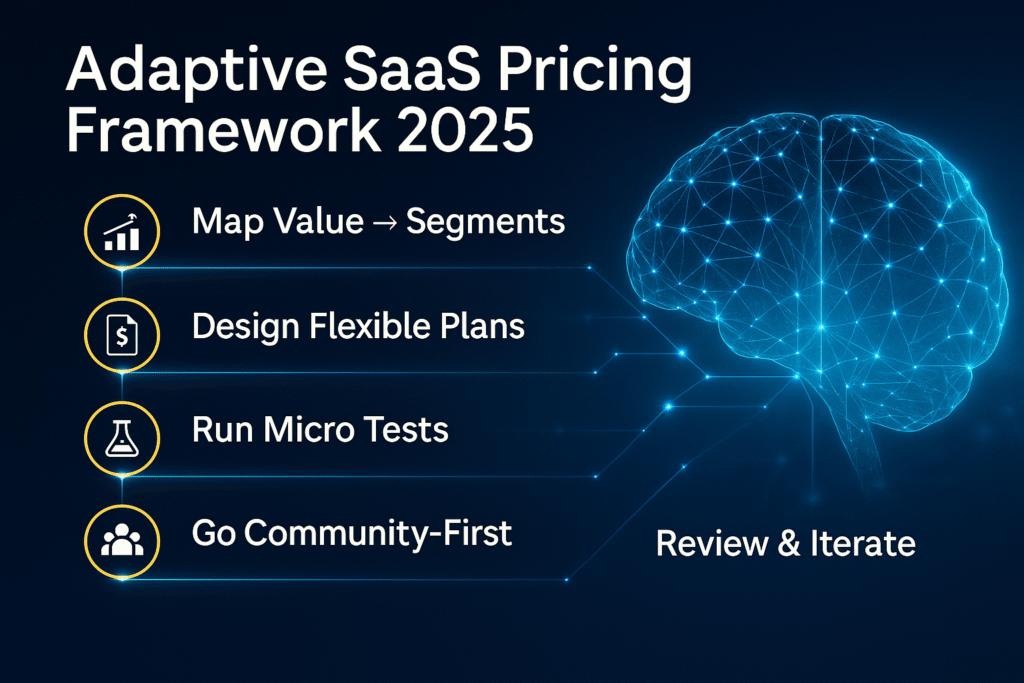
If you’re ready to shift, here’s a straightforward framework I use with SaaS clients breaking into adaptive pricing:
1. Map Value to Customer Segments
Segment your user base by real behaviors, not just firmographics. Identify which customer actions predict retention or expansion. Often, you’ll find 20% of users drive over half your ARR growth. Target them with exclusive adaptive offers or aggressive trial upsells.
2. Design Usage- or Value-Based Plans
Start simple. For example, set three clear pricing “moments”: a light, entry-level plan; a core mid-tier linked to top features or usage bands; and an upper tier with custom add-ons. Build-in flexibility to respond to in-year market or infrastructure cost changes. I once advised a SaaS platform that saved $100k annually, just by shifting API pricing per data row instead of per user.
3. Launch Micro-Experiments and Gather Real-World Data
Never “big bang” your new adaptive model. Instead, test small cohorts. Monitor leading indicators: onboarding completion, time-to-value, early churn, and upgrade rates. Within weeks, you’ll see where customers experience sticker shock or friction. Adjust your messaging and feature bundling on the fly.
Want more on testing and iteration? Read: SaaS pricing experiments and pricing A/B test best practices .
4. Make SaaS Content Marketing and Community Central to Launch
Do not roll out new pricing in a vacuum. Build content that explains your logic, shows value, and reassures legacy users. Community-led SaaS brands in 2025 see stronger adoption and less backlash because they treat pricing as a two-way conversation.
Connect pricing launches to your PLG motion, and use SaaS content marketing to tell customer success stories. Engage champions in your community to amplify wins and mitigate fears.
5. Set Quarterly Reviews for Pricing Iteration
Commit to 90-day pricing reviews. Measure churn by cohort, NRR, and conversion, not just raw MRR. Use feedback loops from support, sales, and product analytics to tune limits, bundles, and messaging. Your goal: sustainable, defensible ARR growth that scales with real user value.
Suggested visual: Include an “Adaptive SaaS Pricing Feedback Loop” infographic, showing how data, segmentation, experimentation, and messaging feed into each other for constant improvement.
Adaptive SaaS Pricing in 2025: Avoiding Common Mistakes
It’s easy to stumble here. The biggest mistake I see is going “too complex, too soon.” Confusing metered pricing, incomplete usage data, or failing to educate users will spike your support tickets and damage trust. Always lead with clarity, then evolve. For examples of what to avoid, review our lessons learned: Common SaaS growth mistakes 2025 .
Another common pitfall in 2025: ignoring the real cost of SaaS marketing that comes with pricing changes. Messaging, onboarding guides, enablement content, referral updates: these eat resources. Budget realistically and involve your go-to-market teams early.
FAQs: Adaptive SaaS Pricing in 2025
- How much should I spend on SaaS marketing in 2025?
Most high-growth SaaS companies in 2025 allocate 25-40% of ARR to marketing, including content and demand generation. Adaptive pricing often boosts ROI by increasing customer LTV and decreasing CAC. For benchmarks, see SaaS growth ultimate guide . - What is the best way to reduce churn in 2025?
Adaptive pricing combined with product-led growth and clear onboarding flows is the most effective way to reduce churn in 2025. When price aligns with actual value, users are less likely to leave or downgrade. See Reduce SaaS churn with personalization for actionable tactics. - When should a SaaS startup start investing in demand generation?
As soon as you have strong product-market fit and early proof of expansion/conversion. Adaptive pricing models make demand gen cheaper by lowering “try” friction, so include demand-driving campaigns as soon as your ideal customer profile is clear. Learn more: Content marketing for SaaS growth .
Conclusion
SaaS pricing in 2025 must be adaptive to meet buyer demands, drive PLG strategy, and achieve unbeatable ARR growth. By shifting away from static tiers, you unlock more sustainable customer retention and churn reduction, while powering up your b2b SaaS marketing plan. If you’re ready to take your SaaS pricing approach to the next level, UnderBoss Media has the proven frameworks and real-world experience to guide your team. Reach out today and let’s build your next winning pricing strategy together.
READY TO REDEFINE YOUR MARKET?
BUILT SOMETHING GREAT? NOW LET’S SCALE!

Nikola Vuković is the SaaS & FinTech Analyst Writer at UnderBoss Media. He breaks down complex fintech and software trends into clear, data-driven insights that help founders, investors, and marketers stay ahead of the curve.