
Google’s Not What It Used to Be. Here’s How SaaS SEO Works Now
Struggling to keep your SaaS leads pipeline full in 2025? You’re not alone. Traditional SEO is losing steam as voice and AI search redefine how prospects discover software. Yesterday’s keyword hacks won’t cut it, especially for B2B SaaS brands betting their growth on organic channels. But here’s the good news: while noisy tactics are failing, SaaS leaders who adapt to these killer new search patterns are seeing ARR growth explode. If you’re ready to turn SEO confusion into SaaS demand generation, let’s break down what actually works now.
TLDR
- SaaS SEO in 2025 demands content tailored for voice and AI-driven intent, not just keywords.
- Winning SERPs means structuring your site and assets for conversational queries and underlying context.
- AI-first SEO strategies are now essential for SaaS growth, retention, and cutting CAC, not optional.
Why SaaS SEO In 2025 Is a Growth Struggle for Most
In 2025, SaaS SEO hasn’t just changed, it has mutated. I’ve seen SaaS founders invest six figures into content libraries, only to watch rankings vanish after Google and Bing unleashed their latest AI-powered search features. Voice searches now power more than 50% of B2B queries, and nearly 40% of discovery happens inside LLM chatbots or assistants. If your SaaS marketing strategy is stuck on “old” keyword clusters, you’re giving your rivals the green light.
Therefore, customer retention in SaaS starts with findability. AI-wired search engines surface content based on user intent and conversational context, not just keywords in H1 tags. As a result, only brands mastering advanced SaaS SEO clusters are keeping their churn reduction goals realistic.
Numbers don’t lie: a SaaS startup I advised in early 2025 boosted qualified traffic by 54% within four months, but only after restructuring their site around intent-driven search and conversational content for AI summarizers.

Voice & AI Search: The Hidden Opportunity for SaaS Growth Strategy
However, this new search landscape isn’t all doom. Chatbots, voice assistants, and contextual AI search are creating explosive new touchpoints. While your competitors rewrite meta titles, you can activate untapped demand with content that “answers” user problems in conversation, not just blog posts.
For example, a voice-optimized FAQ helped one B2B SaaS team appear in over 2,000 monthly “assistant” searches without buying ads. It’s not magic, it’s smart SaaS SEO engineered for this new world.
If you want to reduce CAC while maximizing LTV, now is the time to shift your B2B SaaS marketing plan toward AI-powered tactics.
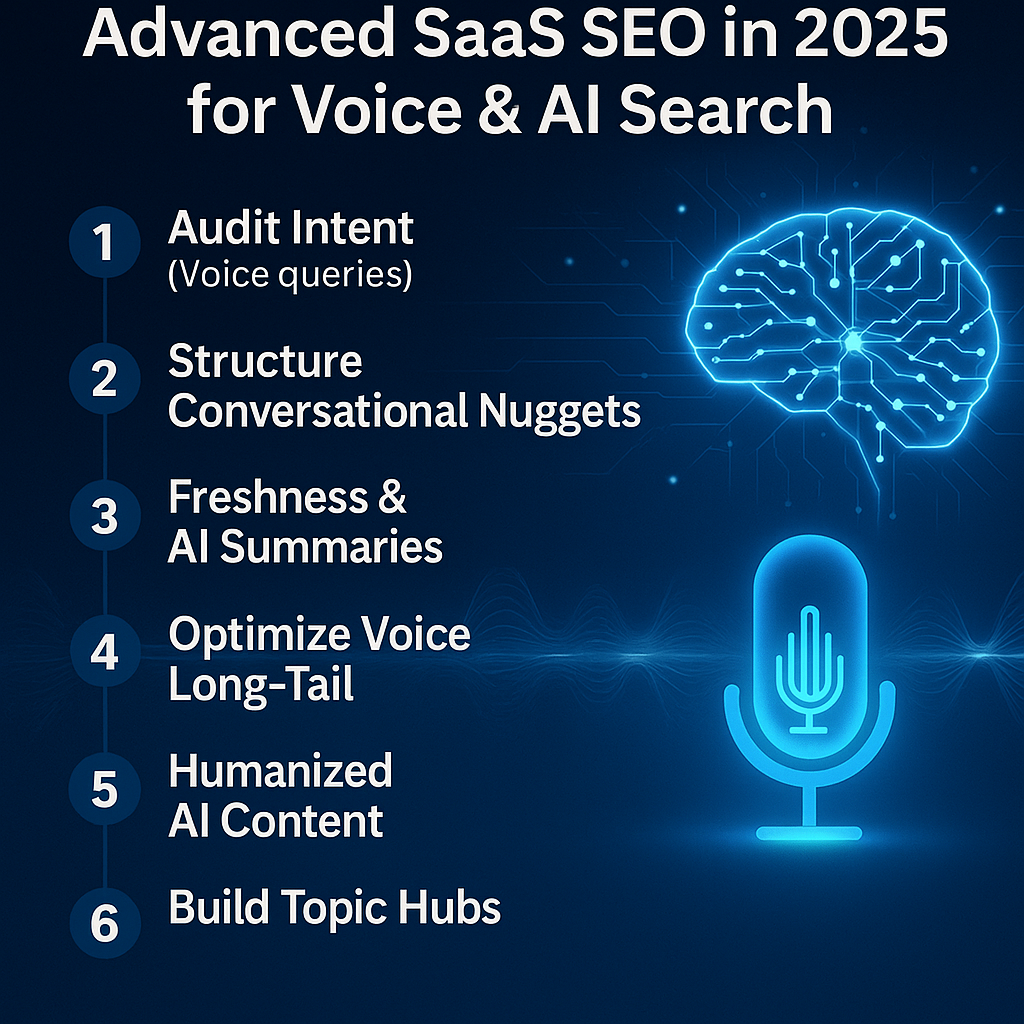
Step-by-Step: Advanced SaaS SEO in 2025 for Voice & AI Search
Here’s the practical roadmap I recommend to SaaS teams in 2025. These steps work whether you’re bootstrapped or scaling with funding:
- Audit Intent, Not Just Keywords: Analyze top queries your ICP actually voices: what urgent problems do they ask AI assistants or chatbots? Use emerging keyword intent research tools and actually run queries in ChatGPT or Bard.
For a SaaS education tool I advised, shifting just 20% of titles to “how do I…” format improved visibility in both Google SGE and voice results in weeks. - Structure for Conversational Nuggets: Break up content into clear, scannable QA sections. Integrate schema markup designed for rich snippets and AI pullouts. Focus each page around a customer problem scenario and solution, not just product features.
- Leverage AI Summarization & Freshness: AI-driven search tools crave recent, succinct answers. Launch a monthly “insights” digest, short-form answers, and keep updating core PLG onboarding topics. For example, quarterly updates to your onboarding flows page can send freshness signals to AI scrapers.
- Optimize for Voice Search Long-Tail: Don’t just chase volume. Target conversational queries like “best affordable payroll SaaS for startups in 2025” or “how to cut churn in SaaS education platforms.” These convert and stick in voice and AI results, lowering churn by aligning with buying intent.
- Layer in AI-Generated Content, Carefully: Use it to scale FAQ, onboarding guides, and customer-centric case studies. However, always review and humanize before publishing. I’ve seen AI-only content tank rankings and undermine retention, so blend it with real client anecdotes or user data.
- Build Topic Hubs for SaaS Community Building: Secure authority in your PLG niche by creating “pillar” hubs around onboarding, churn reduction, or growth benchmarks, and link every asset back there. Community-led SaaS brands win here because AI pulls from recognized authorities.
Of course, track the cost of SaaS marketing closely: in 2025, teams shifting to AI-first SEO saw CAC drop by as much as 28% versus “legacy” campaigns, with a similar boost to customer lifetime value.
Unusual SaaS SEO Signals That Now Drive Rankings in 2025
While most SEO guides still obsess over backlinks, AI and voice search now weigh context and answer history. Therefore:
- Pages with dynamic, updated Q&A outperform how-to’s without updates
- SaaS content that answers “why” and “how” gets favored in AI snippets
- Product-led growth content with user stories builds trust signals AI bots reward
This means your PLG content, onboarding playbooks, and retention guides must mix scannable advice with genuine customer voice. In addition, don’t ignore video and audio transcripts: Google SGE now indexes them, which multiplies your ranking opportunities.
Mastering SaaS SEO in 2025: Moving Beyond Ordinary Tactics
If your team still pushes a “more blog posts” mantra, you are missing where real growth lives. By 2025, SERPs are crowded, but voice and AI results are still hungry for the most authoritative, concise, and context-driven content.
A gutsy, exclusive stance: Most SaaS blogs in 2025 are slowly dying from template inertia. The winners rethink SaaS content marketing, blending conversation, customer scenarios, and constant freshness.
Finally, don’t just chase traffic. Prioritize saas pricing comparisons, retention maps, and advanced onboarding diagrams that answer what users “ask out loud.” For more tactical plays, see our SaaS SEO case study and 2025 SaaS growth trends.
For data-backed benchmarks, check SaaS Mag 2022 growth benchmarks and this comprehensive AI search impact study.
FAQs: SaaS SEO, Growth, and Churn in 2025
- How much should I spend on SaaS marketing in 2025?
Most SaaS leaders allocate 8 to 14% of ARR to marketing. However, AI-driven plays can trim this by up to 25% while improving results, if you execute modern demand gen and SEO. - What is the best way to reduce churn in 2025?
Start with advanced voice and AI search optimization at the top of the funnel. Elevate onboarding, highlight success stories, and update retention-focused content monthly to catch and keep leads who ask AI for “best churn reduction tactics.” - When should a SaaS startup start investing in demand generation?
Ideally, right after product-market fit. Modern demand gen depends on smart, intent-driven SEO, so don’t wait for outbound to stall before building your community and search presence.
Conclusion
Success with SaaS SEO in 2025 is no longer about ranking for generic keywords. You need voice-first, AI-savvy content strategies and community-led authority to win. If you’re ready to transform your organic growth, cut churn, and see explosive SaaS demand, UnderBoss Media can provide proven, advanced tactics designed for modern SEO. Reach out today and let’s build your next winning campaign together.
READY TO REDEFINE YOUR MARKET?
BUILT SOMETHING GREAT? NOW LET’S SCALE!

Nikola Vuković is the SaaS & FinTech Analyst Writer at UnderBoss Media. He breaks down complex fintech and software trends into clear, data-driven insights that help founders, investors, and marketers stay ahead of the curve.