
Most Onboarding Flows Fail!! Here’s How AI Fixes That in 2025
Most SaaS teams in 2025 still struggle with onboarding: users sign up, but too many quietly vanish before they reach value. This silent churn bleeds ARR and buries growth targets. Yet, the opportunity is right in front of us because the latest AI-driven onboarding flows can boost product adoption, accelerate time-to-value, and dramatically reduce churn. If you get this right, onboarding becomes your secret weapon for customer retention in SaaS. I’ve seen first-hand how a few smart tweaks (rather than endless reworks) can yield a 40% reduction in onboarding drop-off within weeks. Here’s what works right now.
TLDR
- AI-driven onboarding flows in 2025 deliver top-tier activation and retention by adapting in real-time to user behavior.
- Personalized touchpoints and quick value delivery are now essential for reducing SaaS churn and CAC waste.
- Smart use of data, journey mapping, and continuous testing unlock explosive SaaS growth.
Why Broken Onboarding Kills SaaS Growth in 2025
I’ve worked with SaaS startups where new users would sign up, nudge around, and drop off by Day 3. The cost of SaaS marketing keeps climbing, so pouring leads into a leaky onboarding experience is like bailing water from a sinking boat. Despite years of flashy “welcome tours,” the core issue remains: generic flows can’t deliver what users crave: relevance, momentum, and support at every click. In 2025, the stakes are even higher because user patience is near zero. Customer retention in SaaS hinges not just on what you offer, but how you get people to their first win.
Instead, leading teams are now using AI-powered onboarding to spot friction, personalize steps, and trigger killer support before users drift. According to SaaS Mag 2022 growth benchmarks, companies with adaptive onboarding flows are seeing 30-50% higher product-led growth rates. If your b2b SaaS marketing plan doesn’t fix onboarding, your latest demand generation playbook may just be fueling your churn problem.
Hidden Opportunity: Building AI-Driven Onboarding Flows for 2025
The good news: SaaS growth strategy can be transformed with the right onboarding upgrades. Because AI can now analyze behavioral data and segment users instantly, you can surface the next best action for each customer without human intervention. For example, one SaaS platform I advised cut their day-one drop-off by 37% after leveraging predictive onboarding steps. Instead of a flat, linear path, users received personalized tasks that matched their industry and use case. The result felt natural, and conversion rates soared.
AI-driven flows are not just for deep-pocketed unicorns, either. With off-the-shelf tools and a little creative mapping, even lean teams can turn onboarding from a struggle into their biggest driver of explosive ARR growth. Learn more about product-led growth if you want to deepen this approach.
Improving onboarding flows with data is now table stakes for serious SaaS teams in 2025. However, “AI” alone is not the differentiator; how you wield it is.
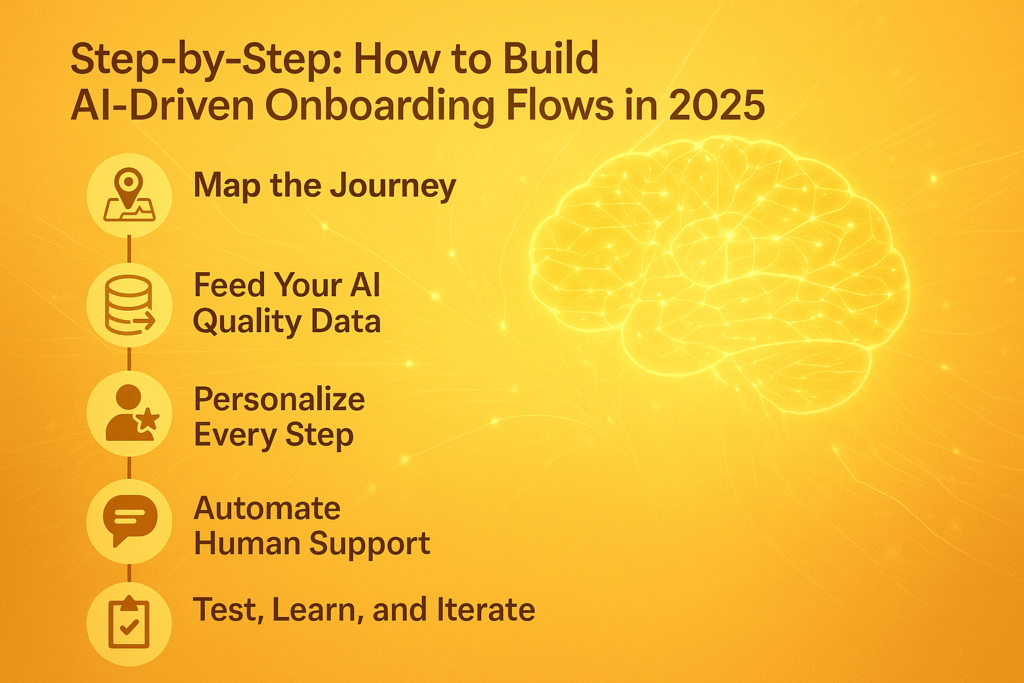
Step-by-Step: How to Build AI-Driven Onboarding Flows in 2025
Step 1: Map the Journey. Don’t Assume All Users Are Alike
Before you train any AI model or plug in a new tool, work through how different user segments first experience your product. For example, trialing a freemium tool looks very different for a solo founder versus an enterprise admin. List their first 5 in-app actions and pain points. This mapping helps your AI onboarding flow trigger the right nudges at the right time. For detailed growth stage mapping, review our Ultimate SaaS Growth Guide.
Step 2: Feed Your AI Quality Data
AI is only as sharp as its data, so you’ll want to track user clicks, time on tasks, feature skips, and help searches from day one. Connect key events to your onboarding engine, not just your analytics dashboard. In one project, simply tracking “failed import attempts” unlocked a killer moment: we preemptively intervened for 12% of users, saving hundreds from silent churn. For more on what to track, see key SaaS metrics every founder should track.
Step 3: Personalize Every Step: Dynamic Content and Next-Best Actions
AI-driven onboarding flows in 2025 adapt on the fly. If a finance persona skips an advanced feature, nudge them toward quick wins relevant to their role instead. Use segmentation and predictive modeling to reorder steps or insert explainer videos only where confusion spikes. Often, the boldest ROI comes from skipping unnecessary steps and accelerating the first value moment. Onboarding strategies to reduce churn go hand in hand with your dynamic flows here.
Step 4: Automate Human Support: Without Losing the Personal Touch
AI chatbots and triggered email support can address routine roadblocks automatically, but some issues demand a gentle human prompt. Blend these by using AI to escalate real struggles to success teams or even smartly timed check-ins. Real users in 2025 want speed, clarity, and a feeling someone’s got their back.
Step 5: Test, Learn, and Iterate Relentlessly
Your AI-driven onboarding flow is never “done.” Use A/B tests, journey heatmaps, and activation rate tracking to optimize every month, not just once a quarter. When a SaaS startup I coached switched from quarterly onboarding reviews to biweekly, they spotted a subtle drop and fixed it in days instead of months, adding an extra 18% activation growth. Tie each experiment back to cost of SaaS marketing to keep ROI high. For tips on running quick onboarding experiments, see The SaaS Growth Playbook.
Best-In-Class Metrics for AI-Driven Onboarding Flows in 2025
What should you measure to know if your onboarding is working?
- Activation Rate: Percentage of new users reaching first key milestone within 7 days. Best-in-class is 60%+ in 2025.
- Onboarding Drop-Off: Share of users bailing before core setup. Top teams now target under 25% drop-off.
- Day 30 Retention: Users who stick around and use premium features. This is your true proxy for sustainable product-led growth.
Compare these with your overall SaaS growth strategy to make sure onboarding is fueling, not stalling, demand generation and ARR goals. Check out this recent report on onboarding metrics for additional benchmarks.
Reducing SaaS Churn with AI-Powered Onboarding Flows
If churn is up in Q2 2025, look to onboarding first: poor fit and low activation are usually the real culprits. Strong AI-driven onboarding flows surface issues fast, triage by segment, and deploy churn reduction tactics before users ever reach the danger zone. For even more ideas, see reducing churn with personalization and advanced churn reduction strategies.
FAQ: Building AI-Driven Onboarding Flows in 2025
- How much should I spend on SaaS marketing in 2025?
Most teams in 2025 allocate 20-30% of annual revenue toward SaaS marketing strategies, focusing on user activation and retention yields the highest ROI. - What is the best way to reduce churn in 2025?
Invest in personalized, AI-driven onboarding flows that quickly surface user intent and remove friction before users drop out. - When should a SaaS startup start investing in demand generation?
Start early, ideally after your first onboarding flow proves product-market fit. This ensures you’re not fueling a leaky funnel.
Conclusion
2025 is the year AI-driven onboarding flows become essential to every SaaS growth plan. If you want explosive user activation and ARR growth, it’s time to make onboarding your competitive edge. If you’re ready to take your onboarding flows or SaaS marketing strategy to the next level, UnderBoss Media can help. Reach out today and let’s build your next winning campaign together.
READY TO REDEFINE YOUR MARKET?
BUILT SOMETHING GREAT? NOW LET’S SCALE!

Nikola Vuković is the SaaS & FinTech Analyst Writer at UnderBoss Media. He breaks down complex fintech and software trends into clear, data-driven insights that help founders, investors, and marketers stay ahead of the curve.