

AI Won’t Replace Product-Led Growth. It’ll Supercharge It
If you run a SaaS company in 2025, you know the product-led growth (PLG) playbook is no longer enough on its own. I’m seeing it firsthand: users expect personalized onboarding flows, smart in-app guidance, and instant support that goes far beyond email sequences or static tours. The struggle? Old PLG tactics stall out when everyone is running the same routines. I’ve worked with dozens of growth teams over the years, and today there’s a common thread: AI is rewriting what “product-led” really means. The good news is, those who adapt can unlock surprising growth levers and outperform their competitors’ SaaS growth strategy.
TLDR
- AI transforms PLG by automating personalized user journeys and optimizing engagement in real-time.
- Smart AI analytics expose hidden churn risks, fueling new customer retention tactics for 2025 SaaS leaders.
- Start small: Focus first on AI-powered onboarding, then expand to AI-driven messaging and upsell paths.

2025: How AI Changes Product-Led Growth Fundamentals
For a decade, most SaaS companies relied on playbooks: self-serve signups, onboarding checklists, and content-driven nurture flows. However, with the explosion of AI tools in the 2025 SaaS growth landscape, everything has shifted. Now, even the smallest SaaS startup can deliver unique onboarding flows that feel hand-crafted for each user persona.
For example, I recently advised a B2B SaaS platform where AI onboarding lifted trial-to-paid conversion rates by 23% in just six weeks. Their secret? An AI engine that analyzes user events in real time, then tailors in-app prompts and product tutorials based on actual behavior. Instead of a single onboarding path, users now see only the steps relevant to their goals, not someone else’s generic checklist.
AI-Powered PLG Funnels: Opportunity Outpaces Risk
The secret weapon in 2025’s winning SaaS growth strategy is clear: AI-driven optimization. Many founders worry about upfront investment or complexity. However, today’s modular tools mean you can add AI-powered features (like automated onboarding or in-app customer success nudges) without a total rebuild.
If cost of SaaS marketing is squeezing your margins, consider this: AI helps reduce your CAC by personalizing flows that move prospects to value faster. That directly improves LTV, especially when combined with PLG funnel best practices.
If you’re not using AI to tweak user journeys in real time, your B2B SaaS marketing plan will struggle to keep up with advanced competitors who have already adopted these tools.
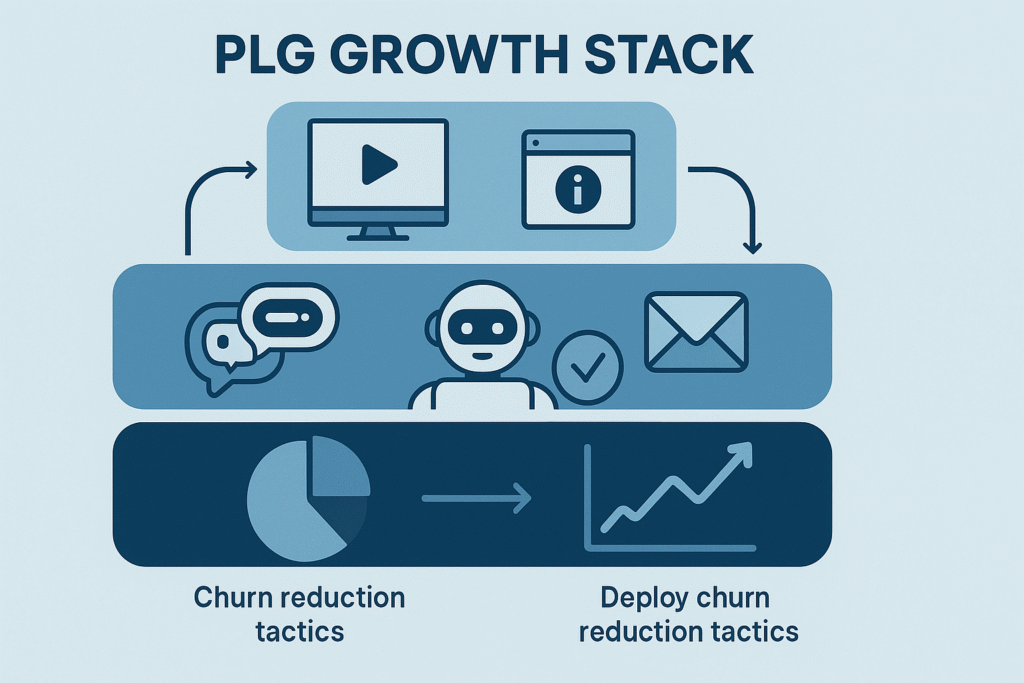
Step-by-Step: Bringing AI Into Your Product-Led Growth Stack (2025)
While the AI hype can feel overwhelming, I recommend starting with focused wins, then expanding. Here’s a proven path I use with clients today:
- Start with AI-powered onboarding: Use AI to map the fastest path to “aha moment” for every new user. This often means real-time recommendations, timed educational popups, or progressive field hiding.
- Layer in AI-driven customer messaging: Trigger help docs, chatbots, or targeted emails based on live user actions, not old-fashioned triggers like “day 3” or “week 1.”
- Deploy churn reduction tactics with predictive analytics: Let AI highlight at-risk segments and push relevant interventions (like renewal offers, training invites, or personalized upsells) before users slip away.
- Analyze and tune: Use modern SaaS analytics, not vanity metrics. Watch how AI-driven flows move the needle on retention and payback period: most teams see a 15 to 25% improvement within the first quarter.
In summary, the move toward AI-powered product-led growth is the rare SaaS opportunity: the sooner you adopt, the stronger your compounding edge. For more step-by-step frameworks, visit Product-Led Growth Basics or see how AI tools for SaaS growth are driving outsized results.
Surprising Benefits: How AI Changes Product-Led Growth in 2025
Some founders fear AI will make onboarding robotic or damage their SaaS community building efforts. The truth is the opposite. Used right, AI can unlock one-to-one personalization at scale: think contextual feature walkthroughs, in-app support for edge cases, or targeted nudges to drive feature adoption.
One client I coached replaced “all users get the same guide” with three dynamic AI-powered onboarding tracks. Trial activation climbed from 8% to 14%, and their net churn dropped below 2% monthly, proving cost of SaaS marketing can fall quickly when growth loops run on relevant automation.
In addition, AI exposes hidden roadmap blockers. By analyzing user behavior patterns, you find surprising product friction, or silence, in places you assumed were solved. We identified a bottleneck in a reporting tool, optimized it, and saw a 1.8x jump in paid upgrades within 30 days.
Still on the fence? Review these best practices on SaaS churn reduction with personalization or see how AI scaling impacts SaaS growth in 2025.
Measuring Success: Core AI Product-Led Growth Metrics
If you want to prove ROI, focus on metrics that matter for PLG and AI. These include:
- Trial-to-paid conversion rate
- User onboarding velocity
- Churn rate and retention cohort analysis
- Feature adoption frequency
Track these from day one. Use them to defend AI investments in any upcoming board meetings (or tough budget conversations).
For detailed metric breakdowns, explore Core SaaS metrics for 2025 and read this comparison of CAC vs. LTV in scaling SaaS.
FAQs
How much should I spend on SaaS marketing in 2025?
Budgets vary, but most fast-growing teams in 2025 invest 20 to 35% of ARR back into SaaS marketing strategies, including AI-driven demand generation and product-led growth campaigns.
What is the best way to reduce churn in 2025?
Combine AI-powered customer segmentation with proactive, in-app interventions. The most effective tactics focus on triggering help or upsell offers based on usage signals, not just purchase history.
When should a SaaS startup start investing in demand generation?
Start as soon as you reach product-market fit and see repeatable activation patterns. Early investment in targeted demand generation pays off when layered over a strong PLG funnel.
Conclusion
AI is not just a trend, it’s the essential growth engine for modern product-led SaaS teams in 2025. The strongest results I see come from those who embrace new AI strategies early and iterate fast, not those who wait. If you’re ready to take your product-led growth to the next level, UnderBoss Media can help. Reach out today and let’s build your next winning campaign together.
READY TO REDEFINE YOUR MARKET?
BUILT SOMETHING GREAT? NOW LET’S SCALE!

Nikola Vuković is the SaaS & FinTech Analyst Writer at UnderBoss Media. He breaks down complex fintech and software trends into clear, data-driven insights that help founders, investors, and marketers stay ahead of the curve.